
Resources
Asbestos testing before you buy or renovate
If your home was built or renovated before 1990, test for asbestos before you renovate or demolish. An inspection identifies suspected materials and samples are analysed by a laboratory. Any removal is then carried out by licensed asbestos removalists in line with SafeWork NSW requirements.
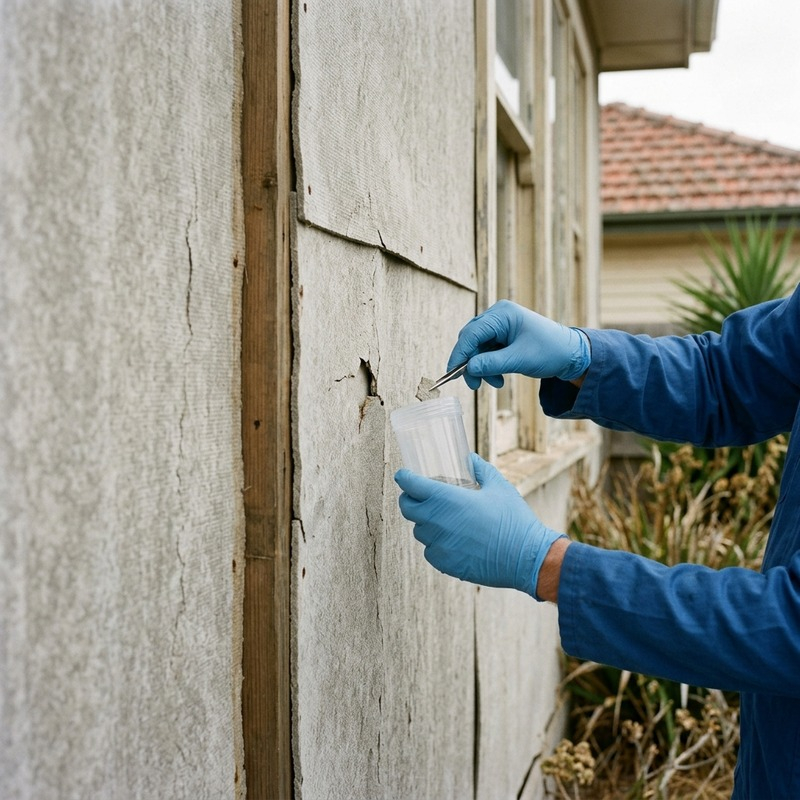
Buying an older home or planning a renovation means committing money before you know exactly what is in the walls. If the house was built or renovated before the national ban on asbestos products, the safe assumption is that asbestos may be present, and the time to confirm it is before anything is cut, drilled or pulled down. Max Demolition and Excavation is a licensed NSW demolisher, licence AD214737, based at Auburn and working across Sydney and NSW, and asbestos inspections and testing is where most of our residential projects begin. This article explains what an inspection involves, what the laboratory result tells you, and what happens next if asbestos is confirmed. All removal work referred to here is carried out by licensed asbestos removalists in line with SafeWork NSW requirements.
Should you test for asbestos before renovating
Yes, if the building predates the national ban on asbestos products, or has been patched and extended using materials of that era. Asbestos is a risk when it is disturbed, and renovation and demolition are the two activities that disturb it most, which is why the question arrives at exactly this point in a project.
There are three practical reasons to test rather than assume. The first is that you cannot identify asbestos reliably by eye, so an assumption either way is a guess. The second is that your builder cannot safely or lawfully proceed on a guess: SafeWork NSW requires asbestos to be identified before work that may disturb it, and that obligation sits with the person conducting the work. The third reason is commercial. An unknown asbestos scope is the most common reason a renovation or demolition quote changes after it has been awarded, because the material reveals itself once something is opened up and the job then stops while it is dealt with.
Booking asbestos inspections and testing early turns all of that into a known quantity before you commit to a price or a start date.
Why you cannot tell by looking
Asbestos cement sheeting and modern fibre cement board look very similar once installed. Both are flat, grey and hard, and the difference sits in the fibres bound inside them rather than anything visible on the surface. Paint, render, tiles and later cladding hide the original material completely, so what you are looking at may not be what is actually there. The only reliable identification is laboratory analysis of a sample. That is why a photograph cannot answer the question, and why an inspection records suspected materials for testing rather than declaring them asbestos on sight.
Where asbestos turns up in Australian homes
Asbestos products were used widely in Australian housing for decades, so in a pre-1990 home the material tends to appear in the same handful of places. Grouping them by type is useful, because bonded and friable materials are treated differently once testing confirms what they are.
Bonded (non-friable) materials, where the fibres are held in a solid matrix:
- Wall sheeting and external cladding. The familiar fibro sheet, used for whole walls, infill panels, garages and sheds.
- Eaves and soffits. Flat sheeting under the roofline, usually painted and easy to overlook.
- Roofing sheets. Corrugated cement roofing on houses, carports and outbuildings.
- Wet-area linings. Sheeting behind tiles in bathrooms, laundries and kitchens.
- Vinyl floor tiles and their backing. Both the tile and the bituminous backing or adhesive beneath it.
Friable materials, where the fibres are loose or crumbly:
- Pipe lagging and insulation. Wrapping around hot water pipes and inside older heating systems.
Soil is the one most people do not expect. On older properties where fibro was broken up during a past renovation, buried in the yard, or left to weather in the open, fragments work their way into the ground. Asbestos-contaminated soil is a separate scope involving excavation, classification and disposal at licensed facilities rather than sheet removal, and worth knowing about before you plan footings or landscaping.
Bonded versus friable, and why the difference matters
Bonded, or non-friable, asbestos means the fibres are locked into a solid matrix such as cement sheeting. While the material is intact, it holds its fibres. Friable asbestos is loose, crumbly, or able to be reduced to powder by hand pressure, as pipe lagging and some insulation can be, and it releases fibres far more readily.
That difference governs everything that follows. Friable work calls for higher controls on site and is restricted to removalists holding the appropriate class of licence. All removal, bonded or friable, is carried out by licensed asbestos removalists in line with SafeWork NSW requirements, and for friable work independent air monitoring and a clearance certificate follow the removal before the area is used again.
Side by side
Bonded and friable asbestos compared
The distinction is worth seeing side by side, because it drives who is allowed on site and how long that stage of your project runs for.
Consideration | Bonded (non-friable) | Friable |
|---|---|---|
| What it is | Fibres bound into a solid matrix, usually cement sheet. | Loose or crumbly material that can be broken down by hand pressure. |
| Where you typically find it | Wall sheeting, cladding, eaves, roofing, wet-area linings, vinyl floor tiles. | Pipe lagging, some insulation, and sheeting badly damaged by fire or impact. |
| How readily fibres are released | Low while the material is intact. Rises sharply once it is cut, drilled, sanded or broken. | High, even with minimal handling. |
| Who may remove it | Licensed asbestos removalists, in line with SafeWork NSW requirements. | Licensed asbestos removalists holding the appropriate class of licence for friable work, in line with SafeWork NSW requirements. |
| Controls on site | Exclusion zone, signage, PPE, dust suppression, and waste wrapped and sealed for disposal. | Higher controls, including enclosure and decontamination arrangements for the work area. |
| Air monitoring | Not required as a matter of course. Where it is used, it is arranged independently. | Independent air monitoring is carried out as part of the removal process. |
| Clearance certificate | Issued independently where the scope, the builder or the certifier calls for it. | An independent clearance certificate follows the work before the area is reoccupied. |
| Typical effect on your programme | A defined stage that runs before the trades start. | A longer stage, with more set-up, monitoring and clearance before the next trade enters. |
You do not need to classify the material yourself. That is what the inspection and the laboratory result do, and the classification then sets the licensing, the controls and the sequencing.
How asbestos testing actually works
Testing is a sequence, and each step produces something the next one depends on. Here is what happens from the first site visit through to the result.
Step 1. The inspection
An inspector walks the building and the property, covering the areas your project will touch and the areas it will not. Suspected asbestos-containing materials are identified by location and type, their condition is assessed, and photographs are taken. The output is a schedule or plan showing where each suspected material sits. That record is a list of what needs testing, not a verdict, and your renovation or demolition scope is built on it.
Step 2. Sampling
Small samples of the suspected materials are taken under controlled conditions and sealed for transport to the laboratory. This is done by a competent person using controls, because taking a sample disturbs the material by definition, and that moment is when fibres can be released. Homeowners should not take their own samples, and nothing here should be read as guidance on how to do so. If you want a material tested, arrange an inspection and have the sampling done properly.
Step 3. Laboratory analysis and the result
The sealed samples are analysed by a laboratory, which determines whether asbestos is present and, where relevant, the type. You receive a report identifying each material, where it sits in the building, and whether asbestos was detected. That report becomes the basis of the removal scope and the pricing that follows, and it is the document a builder, demolisher or certifier will want to see. The laboratory is an independent party to both the inspection and any removal work, which is what gives the result its weight.
What happens if asbestos is found
A positive result on an older Sydney home is normal, and rarely a reason to abandon a renovation. What changes is the scope and the sequence, both easier to manage when you know in advance.
From there you have two honest options, and the material decides which one applies. Material in good condition that your work will not disturb may be able to be managed in place and recorded, so it is known and monitored rather than removed. Material that your work will disturb has to come out before the work proceeds.
Removal is carried out by licensed asbestos removalists in line with SafeWork NSW requirements. The material is wrapped, transported and disposed of at facilities licensed to accept it under NSW EPA requirements, and where the material is friable, independent air monitoring and a clearance certificate follow the work. Booking licensed asbestos removal as soon as the result lands keeps the job moving.
If your project involves taking the structure down rather than working around it, that work happens before the knockdown rebuild demolition stage begins. Asbestos comes out before the trades or the machines start, which is why testing early protects the programme rather than delaying it.
Max Demolition and Excavation delivers the scopes that follow a positive result: bonded removal, friable removal, asbestos-contaminated soil removal, disposal, and emergency clean-up where material has been damaged by storm, fire or accident.
What a clearance certificate is
A clearance certificate is a document issued after removal work by an independent competent party, confirming the area has been assessed as suitable for reoccupation or for the next stage of work. For friable removal, independent air monitoring is carried out as part of that process. The word that matters is independent: the certificate is not issued by the removalist or the demolisher who carried out the work, and it is not something Max Demolition and Excavation issues. Keep it on file. It is the document your builder, your certifier and a future buyer will ask to see.
Testing before you buy
A standard building and pest inspection is not an asbestos assessment. It may note that a property appears to contain fibro, but noting is not testing, and a line in a report is not a scope you can price work from.
A pre-purchase asbestos inspection establishes whether asbestos is present and where it sits in the building. For a buyer who intends to renovate, extend or knock down, that materially changes the numbers, because the removal work stops being an unknown and becomes a defined scope a builder or a residential demolition contractor can quote against. An unknown cannot be priced. A scope can.
The practical complication is access. Sampling on a property you do not own yet has to be arranged with the vendor or the agent, so it is worth raising early rather than in the last week before exchange.
Common questions
Frequently asked questions
The questions we are asked most often before an inspection is booked.
Can I take my own asbestos sample?
How long does asbestos testing take?
Does asbestos have to be removed?
Is asbestos in soil a problem on older blocks?
What if asbestos has already been damaged in a storm or a fire?
Final thoughts
Testing does one useful thing above all else: it turns an unknown into a scope. A known scope is what lets a builder price properly, a demolisher sequence the job correctly, and your renovation or purchase stay on programme and on budget rather than stopping the week the first wall comes off. Where removal is needed, it is carried out by licensed asbestos removalists in line with SafeWork NSW requirements, with independent air monitoring and a clearance certificate following friable work.
Asbestos testing
Find out what is there before you commit
Send the address and the age of the building and we will arrange an inspection and sampling before anything is cut, drilled or pulled down.
- Demolition licence AD214737, issued by SafeWork NSW
- Samples analysed by a laboratory, independent of the removal work
- Removal by licensed asbestos removalists, clearance by an independent assessor