
Resources
House demolition cost in Sydney: what actually moves the price
Demolishing a house in Sydney is priced on the job in front of you, not a flat rate. Access, size, construction type, asbestos, service disconnections and how much spoil leaves site drive the figure. Max Demolition and Excavation confirms yours after a formal site inspection.
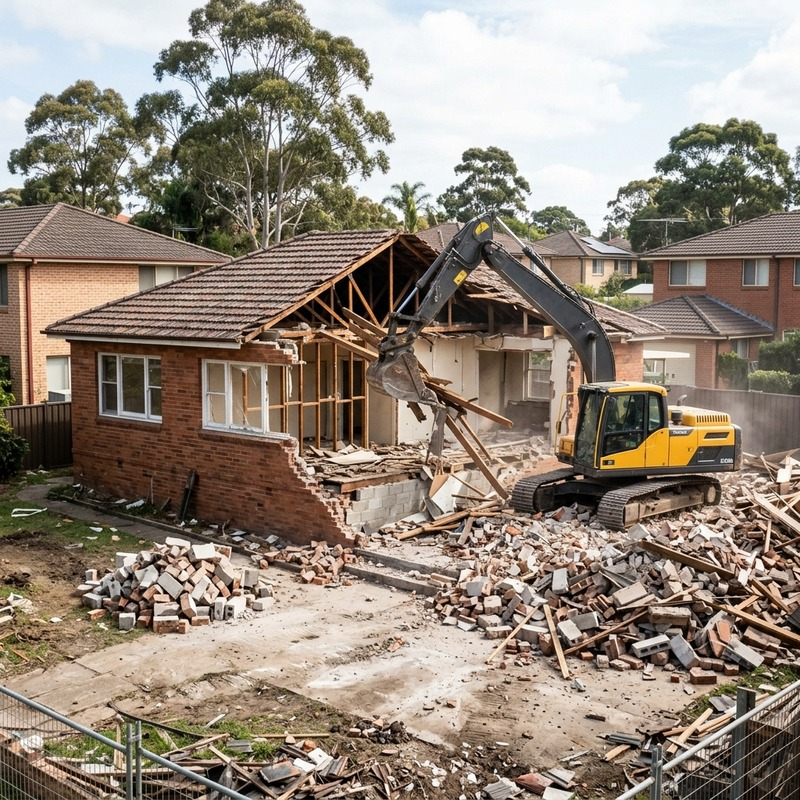
Two houses on the same street can be quoted very differently for demolition. Demolition in Sydney is priced on the specific site rather than from a rate card, and the biggest variables are how easily trucks and machines get in, what asbestos is present, and how much material has to leave the block. Max Demolition and Excavation is a licensed NSW demolisher, licence AD214737, based at Auburn and working across Sydney on everything from single cottages to a full knockdown rebuild. By the end of this article you will know every factor that moves your number, and what a demolisher needs to see before anyone can put a figure on it.
What does it cost to demolish a house in Sydney
You will find averages published for house demolition in Sydney. They are close to useless for any individual block, and the reason is straightforward. The same floor area can double in price once you add a tight driveway, bonded asbestos sheeting and a concrete pool in the backyard.
Where ranges are quoted across the demolition trade, they are industry-general figures drawn from many different jobs on many different sites. They are not our prices and they cannot be read as a quote for your property. The only accurate figure comes after a formal site inspection.
That is why Max Demolition and Excavation does not quote a firm price before inspecting the site. A number produced from an address and a floor area has nothing holding it up, and one that lands low is worse for you than no number at all, because your budget gets built around it. What we can do before an inspection is talk through the likely scope and tell you which parts of your block are the ones that will move the figure.
Why nobody can price your house from a postcode
On a site visit the first thing assessed is access: how a truck gets in, where it turns, and whether there is kerbside room to load. After that comes the distance from the structure to neighbouring walls and boundaries, the construction era and materials, any visible fibro or other suspected asbestos, how deep the slab and footings run, whether there is a pool, retaining walls or mature trees, and where water, sewer, gas and power enter the property. Every one of those changes the plant on site, the labour hours, the number of truck movements or the disposal cost.
The factors that move your demolition price
No two Sydney blocks price the same way, but the variables behind the difference are predictable. These are the ones that do the real work on your number.
Size and construction type
Floor area matters less than what the house is made of. A single-storey weatherboard cottage comes down quickly and produces volume rather than weight, so the cost sits in truck movements. A double-brick 1960s home produces tonnes, and tonnes drive cartage and disposal. A two-storey brick-and-tile house adds height, more structure to bring down under control and more material again. Multi-unit and apartment block demolition is a different scope with its own methodology and is priced separately.
Site access and street frontage
This is the biggest hidden cost driver in Sydney. A block with a wide driveway and kerbside room for a truck and dog costs far less to clear than a narrow battleaxe or a terrace with a single traffic lane out the front, because the equipment response has to change. Tight residential blocks and sites hard up against neighbouring buildings call for zero tail swing machines that can work without swinging over a boundary, and backyard or tight-access work usually means mini excavators. Where a truck and dog cannot get in, material leaves in bogie tippers or 10-wheeler tippers instead. Smaller trucks mean more loads, and more loads mean more cost.
Asbestos
Asbestos is the most common reason a demolition quote moves after inspection, because the scope depends entirely on what is present and whether it is bonded or friable. All asbestos removal is carried out by licensed asbestos removalists in line with SafeWork NSW requirements, and independent air monitoring and a clearance certificate follow friable work.
The cost logic follows the material. Bonded sheeting is removed, wrapped and disposed of at licensed facilities as a defined scope. Friable material requires enclosure, higher controls, air monitoring and clearance, so it sits well above bonded work. Asbestos-contaminated soil adds excavation and classified disposal on top of both. Establishing the position through asbestos inspections and testing before anyone quotes is what keeps this out of the variations column later.
Slabs, footings, pools and retaining walls
What sits under the house often costs more to remove than the house itself, and your builder decides the scope. Some want the slab, footings and pool out with the site cut to a nominated level. Others want the slab left where it is. Deep strip footings, piers, basements and brick or sandstone retaining walls all add work, and reinforced concrete adds more again, because it brings in hammers and grapples and sends a lot more tonnes out the gate.
Spoil, waste volume and classification
Cartage and disposal are a major share of any demolition bill. Where material goes depends on how it is classified under NSW EPA waste classification, and that is decided by what the material is rather than where it came from. Demolition waste is sorted for recycling where possible, with concrete, brick, metal and timber separated from general waste.
The limit on estimating any of this from a desk is that nobody can judge truck movements without seeing the structure and the access. Spoil removal and cartage is priced on what is actually leaving your block.
Service disconnections
Water, sewer, gas, electricity and telecommunications all have to be disconnected or made safe before demolition starts. These are arranged with the relevant authorities and providers rather than by the demolisher, and what catches people out is lead time rather than cost. Applications sit in queues, and site works cannot begin until disconnections are confirmed. Starting this as soon as your approval pathway is clear protects the programme more than anything else you can do.
Approvals, protection work and neighbour requirements
Your approval pathway and the conditions attached to it carry cost of their own. Hoarding or fencing, dust and noise controls, protection of adjoining walls, and traffic or footpath management are all site costs, and they are heavier on tight inner-city and terrace blocks than on open suburban ones. A terrace sharing a party wall needs protection work that a free-standing house on a wide block does not. The approval route sits within the NSW planning system and is worth confirming early.
Trees, vegetation and site clearing
Trees, stumps, overgrown vegetation and accumulated rubbish are a separate scope from the structure, and they are easy to overlook when you are looking at the house. Tree removal may be subject to council controls, so check that early. Clearing is usually priced alongside the demolition because the same machines and trucks are already on site.
Programme, staging and access windows
Anything that stretches the programme stretches the cost. Staged demolition, hand demolition where machines cannot reach or the work has to be precise, restricted work hours and shared-driveway access all add days. Max Demolition and Excavation trades 24 hours, so out-of-hours coordination can be discussed where a site calls for it, though approval for out-of-hours work rests with the relevant authority.
Side by side
Straightforward versus complex: a Sydney demolition comparison
Most of these variables show up in combination. The table below sets the two ends of the range side by side so you can see where your own block is likely to sit.
Factor | Straightforward site | Complex site, expect a higher figure |
|---|---|---|
| Access | Wide driveway with kerbside room to load. | Battleaxe block or single-lane terrace frontage. |
| Truck type that fits | Truck and dog. | Bogie or 10-wheeler tipper, so more loads. |
| Construction | Single-storey weatherboard or light brick. | Double brick or two storeys, with heavy footings. |
| Asbestos | None suspected, or bonded sheeting in a defined area, removed by licensed asbestos removalists in line with SafeWork NSW requirements. | Friable material or contaminated soil, removed by licensed asbestos removalists in line with SafeWork NSW requirements, with independent air monitoring and a clearance certificate following friable work. |
| Under-slab scope | Slab and footings stay in place. | Slab, footings and pool out, site cut to a nominated level. |
| Neighbour proximity | Clear setbacks on both boundaries. | Shared or adjoining walls needing protection work. |
| Pool or retaining walls | Neither on the block. | Concrete pool plus brick or sandstone retaining walls. |
| Likely programme | Short and continuous. | Staged, with hand demolition and restricted work hours. |
Most Sydney blocks land somewhere between those two columns. The point of the table is not to let you quote yourself. It is to let you predict which conversations you are going to have, so that when a demolisher raises protection work or an under-slab scope at the inspection, you already know why it is on the list.
How a demolition quote is actually built
The process runs in the same order every time, because each step produces information the next one cannot be done accurately without.
It starts with an enquiry and basic site details: the address, what is on the block and what you are planning to build. Next comes the formal site inspection, where access, construction, services and the surrounding properties are assessed in person. Where asbestos-containing materials are suspected, an assessment and laboratory testing establish what is actually there. Then the required finish level is confirmed with your builder, including whether the slab, footings and any pool stay or go, and the approval pathway is confirmed. Only after all of that does a written scope and price come back to you.
The written scope sets out what is included and what is listed separately, which usually means the asbestos removal scope confirmed after testing, and disposal costs that depend on classification. We price residential demolition after the inspection and never before it, because that is the only way the number holds.
What to have ready before the site inspection
Bring these to the inspection and the scope that comes back will be accurate rather than hedged:
- The property address, plus notes on driveway width, street frontage and anything that restricts truck access.
- Your approval status, or the pathway you are following.
- The builder's required site finish, and whether the slab and footings stay or go.
- Any asbestos reports you already hold.
- Known pools, retaining walls, basements or underground tanks.
- Tree locations, and anything on the block you want retained.
- The date the site needs to be clear for the next trade.
The more of that you can answer on the day, the fewer assumptions end up inside your price.
Where homeowners and builders get caught out
The first is accepting a figure from someone who has not been to the site. It feels efficient early on, but that figure moves once the site is actually seen.
The second is comparing quotes that cover different scopes. One may exclude asbestos removal pending testing, another may exclude slab and footing removal, and a third may include both. Read what each quote leaves out before you read the totals, because the lowest figure is often the one covering the least.
The third is leaving service disconnections too late. Those lead times sit outside everyone's control, and a site that is otherwise ready cannot start while a disconnection is still pending.
The fourth is assuming the block will be build-ready once the house is gone. Build-ready means whatever your builder has specified, and if that specification is not written into the demolition scope, you end up paying for a second mobilisation to finish the job.
What you can control to keep the cost sensible
Plenty about a demolition price is set by the block itself. These four things are not:
- Establish the asbestos position early. An inspection and laboratory testing turn an assumption into a known scope, and assumption is the single biggest source of movement in a demolition quote.
- Put the whole site under one contract. Max Demolition and Excavation manages demolition, asbestos, site clearing, excavation and cartage on one contract, so plant and trucks mobilise once instead of three times.
- Confirm the builder's required finish level in writing before anyone quotes, so every quote you receive is priced on the same scope.
- Start service disconnections as soon as the approval pathway is clear, because that lead time is the one that most often holds a site up.
Our demolition services cover the full sequence from the first wall to the last load out.
Common questions
Frequently asked questions
The questions we are asked most often before a site inspection is booked.
How long does it take to demolish a house in Sydney?
Do I need an asbestos report before demolition?
Does the slab have to come out?
Can you demolish just part of the house?
Who pays for service disconnections?
Final thoughts
The price follows the site, so the useful next step is always the same: get someone licensed to look at it. Access decides what plant and trucks can work on your block, and how many loads it takes to clear it. Asbestos decides whether the scope is a defined removal or a larger controlled one, carried out by licensed asbestos removalists in line with SafeWork NSW requirements. What leaves the block, and how it is classified, decides the cartage and disposal share of your bill.
House demolition
Get a figure that holds up
Send the address and what you are planning to build, and we will inspect the site before anyone puts a number on it.
- Demolition licence AD214737, issued by SafeWork NSW
- Priced after a formal site inspection, never from an address alone
- Demolition, asbestos, clearing, excavation and cartage on one contract