
Blogs
How long does it take to demolish a house in Sydney
The machine work is the short part. Planning approval, utility disconnections and asbestos assessment sit either side of it, each depends on a third party, and together they set the calendar. Max Demolition and Excavation confirms the sequence for your block after a formal site inspection.
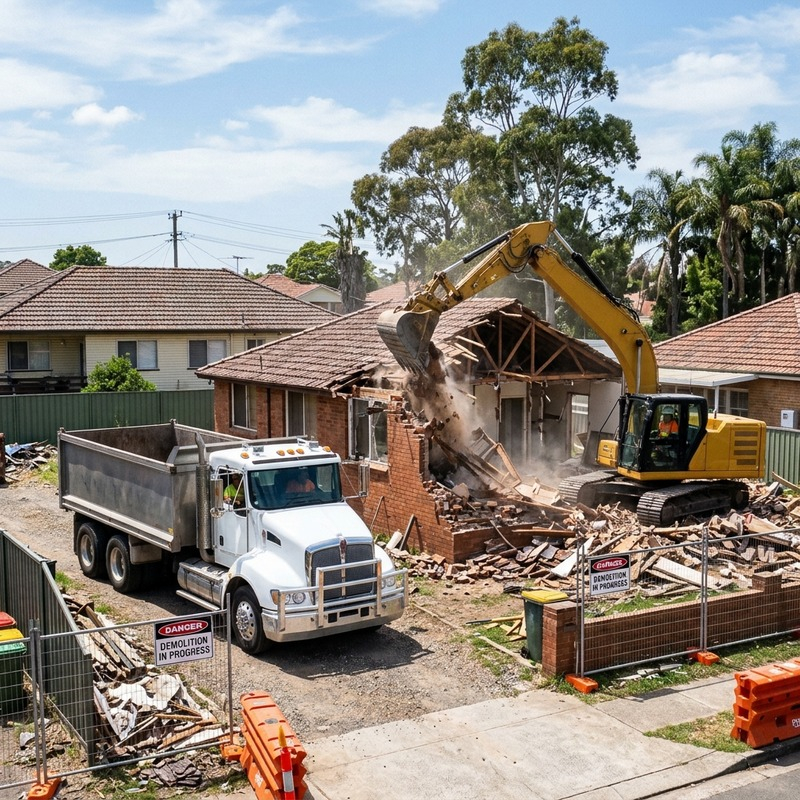
When people ask me how long does it take to demolish a house, they are picturing the excavator and the dust, and that is the quickest stage of the job. The machine work is a small slice of the program. What sets the calendar is everything that must be finished before a machine can touch the building, which in New South Wales means planning approval, utility disconnections and, on an older house, asbestos assessment and licensed removal. Those stages run in sequence, each depends on a third party, and none can be rushed with bigger plant. This article separates machine time from project time so you can see where the weeks sit, the first thing we work through with anyone planning residential demolition across Sydney.
Machine time against project time
Machine time is the physical knockdown, the hours or days an excavator spends bringing the structure down and processing material into loadable sizes. On a single storey detached house with clear access and no attached neighbours, that is short work.
Project time is the whole program, from the day you decide to demolish to the day the site is handed over clear and level. It takes in approvals, disconnections, hazardous material work, the knockdown, then clearance and levelling, and it is almost always dominated by the stages either side of the machine. Every stage is scope dependent, which is why nobody should put a number on your job before a formal site inspection.
What moves the calendar
What makes one site slower than another
The same size house can run very differently depending on the block. These are the factors that consistently decide whether a program runs tight or stretches.
| Factor | What it does to the program |
|---|---|
| Access | Narrow frontage, a steep driveway, overhead powerlines or restricted truck turning slow loading and limit the plant that can be used. |
| Neighbouring structures | Party walls, close dwellings and shared services mean protection works, propping and a more deliberate sequence. |
| Heritage | Listings, conservation areas and partial facade retention conditions lengthen the approval route and slow the method, because hand demolition around retained fabric takes longer than a full knockdown. |
| Hazardous materials | Asbestos is the common one, but lead paint, synthetic mineral fibre and contaminated soil all add handling steps. |
| Wet weather | Rain affects sediment control, truck movements on soft ground and safe machine operation, and lost days are rarely recoverable. |
| Council conditions | Restricted work hours, traffic management and noise limits compress what is achievable each day. |
None of this can be judged from an address. It is confirmed at a formal site inspection, which is where the scope and sequence for your property are set.
Stage one, approvals and the NSW consent pathway
This stage usually sets the start date, and it sits outside a contractor's control. In New South Wales, demolition is development and needs an approval pathway. The NSW Department of Planning, Housing and Infrastructure administers the framework that determines whether your demolition can proceed as complying development, certified against the relevant State policy, or needs full development consent through a development application. Which pathway applies depends on the property, its zoning, the constraints attaching to the land and whether the site carries a heritage listing or sits in a conservation area.
The relevant local council is the authority for the site specific side. Councils set and enforce the approval conditions, and those routinely cover things that directly affect your program, such as permitted work hours, traffic management, hoarding on the footpath, tree protection, sediment control and notification of adjoining owners. A hoarding permit or road occupancy arrangement is a separate council process on its own timeframe. Conditions also reveal extra requirements, and one calling for a dilapidation report on neighbouring properties, an arborist report or a traffic management plan adds work that must be done before demolition begins.
Stage two, utility disconnections
A house cannot be demolished with live services connected, and this is the stage people underestimate most. Electricity, gas, water, sewer and telecommunications each have their own provider, application, inspection and queue. They cannot be lodged as one request, and the lead time for each is set by the provider, not by you or your contractor.
Water and sewer can involve physical works at the boundary. Lodge the applications as early as the approval position allows and treat the slowest provider as the one governing your start date. Where asbestos is involved, removal has to be sequenced around the disconnections, because it often needs access to the same areas where services run.
Stage three, asbestos assessment and removal
On any house built or renovated before the late 1980s, asbestos must be assumed present until testing says otherwise, and the assessment belongs before demolition, not during it. Asbestos cannot be identified by sight, so the first step is sampling and laboratory analysis.
If asbestos containing material is confirmed, SafeWork NSW sets the licensing requirements. Non friable material above the SafeWork NSW threshold requires a removalist holding at least a Class B licence. Friable material requires a Class A licence, independent air monitoring by a licensed asbestos assessor and a clearance certificate before the area returns to use. SafeWork NSW also requires notification before licensed removal begins, and that period sits inside your program.
Sheeting, eaves and wet area linings are where most non friable work is found, so arranging bonded asbestos removal before the machine arrives is standard sequencing on older Sydney housing stock. The waste side is governed by the NSW Environment Protection Authority, which sets how asbestos waste is classified, transported and disposed of at a lawfully permitted facility, and that tipping forms part of the removal stage. Asbestos therefore adds a distinct block of work with its own notification, clearance step and paperwork, and it does not run in parallel with demolition.
Stage four, the physical demolition
With approvals in hand, services disconnected and hazardous material cleared, the knockdown is the most predictable stage. Method depends on the building. A detached house with room to work is a machine job.
A semi detached or terrace sharing a party wall needs a far more controlled sequence, with temporary propping, careful separation at the shared wall and weatherproofing of the exposed neighbouring surface. That is slower by nature and it is the right way to do it. Soft strip, the removal of fittings and recoverable material, is usually done first, which lifts recycling recovery.
Stage five, clearance, cartage and levelling
Once the structure is down, the material has to leave. Volume is the driver, and it follows the building's size, construction type and how much can be separated into recoverable streams. Concrete, brick, timber, metal and clean fill go to different destinations, and the NSW Environment Protection Authority sets the waste classification framework determining what can go where and what documentation travels with each load.
Where material is contaminated or the classification is uncertain, further testing may be needed before a facility accepts it, which is a real timeline factor. Organising demolition waste removal and recycling as part of the demolition scope rather than as an afterthought is what keeps this stage from blowing out.
Final levelling and leaving the site safe and stable completes the handover. If a site cut follows for the new build, that is a separate scope with its own program.
Common questions
Frequently asked questions
The questions we are asked most often before a site inspection is booked.
How long does demolition of a building take?
Do you need permission to demolish?
What makes one demolition take longer than another?
Final thoughts
The machine work is the part everyone pictures and the part that takes the least time. The calendar is set by approvals, by the slowest utility provider in the queue, and by whatever the asbestos assessment turns up, and all three sit with third parties rather than with your contractor. Start those three early and the knockdown becomes the straightforward stage it should be.
Max Demolition and Excavation is a licensed demolition, excavation and asbestos contractor in Auburn NSW, operating under NSW licence AD214737 with more than five years in business. If you are planning a knockdown in Sydney, get in touch with our team to arrange a formal site inspection.
Residential demolition
Get a program that holds its dates
Send the address and your approval position, and we will inspect the site before anyone commits to a start date.
- Demolition licence AD214737, issued by SafeWork NSW
- Priced after a formal site inspection, never from an address alone
- Demolition, asbestos, clearing, excavation and cartage on one contract