
Resources
Rock excavation on the Northern Beaches: sandstone, shale and what changes
On the Northern Beaches and North Shore, sandstone and shale often sit within a metre of the surface. Once you hit rock, excavation shifts from buckets to rock hammers and rippers, the programme stretches, and vibration and noise management for neighbours becomes part of the job.
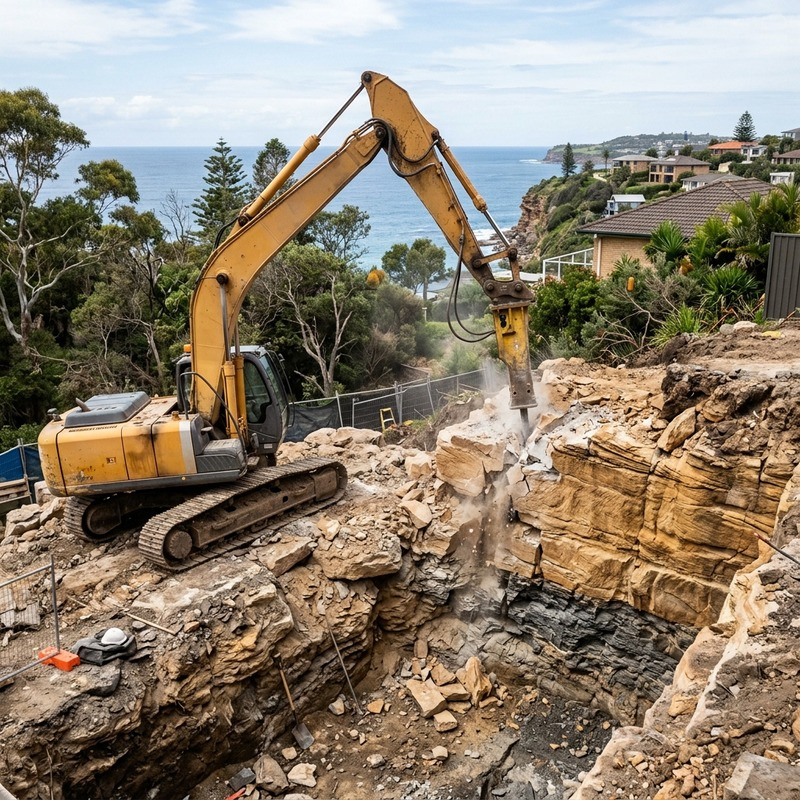
On the Northern Beaches and the North Shore you often hit sandstone or shale within a metre of the surface, and that one fact rewrites the whole excavation. Once you are into rock, buckets stop being useful: hammers and rippers take over, the programme stretches, and rock excavation becomes as much about managing noise, vibration and the neighbours as it is about moving material. Max Demolition and Excavation is a licensed NSW demolisher, licence AD214737, based at Auburn and working the Northern Beaches, the North Shore and Greater Sydney. What follows is a practical account of what changes when rock appears, and how to plan for it rather than be surprised by it.
What you are digging into on the Northern Beaches
Across the Northern Beaches and the North Shore the ground is sandstone and shale, and it sits close to the surface. In Manly, Manly Vale, Dee Why, Brookvale, Narrabeen, Mona Vale and Frenchs Forest, and across Chatswood, Killara, Lindfield and Hornsby on the North Shore, excavations meet rock early and often.
What catches people out is how much the depth varies. It changes across a single block, and it can change within a single excavation, so one corner of a pool shell is in soil while the other is already in rock. That makes an assumed soil depth a weak basis for a price, and a figure built on that assumption moves the moment the machine finds the rock shelf.
It matters for every kind of job in this geology. Sandstone and shale excavation sets the method for pools, basements, garages and footings alike.
The same applies to the site cut for a knockdown rebuild demolition, where the platform level decides how much rock has to come out before anything gets built.
Why a geotechnical report matters more than a guess
A geotechnical investigation puts evidence behind the question. Boreholes or test pits indicate depth to rock, the rock type and its strength, and that is what allows an excavation to be priced on volumes rather than assumptions. It is specialist consultant work, engaged by the owner or the builder, and the excavation contractor works to what it says. Without one, the rock component is an unknown, and an unknown has to be carried as a contingency by somebody. Owners who get the investigation done before quoting tend to get quotes they can compare, because every contractor is pricing the same ground.
Hammers or rippers: how rock is actually broken out
Rock on these sites is broken mechanically, and there are two tools that do it. Which one suits your excavation depends on the rock itself, and most jobs end up using both.
Rock hammers
A hydraulic rock hammer mounts on an excavator and delivers repeated percussive blows that fracture the rock. It is sized to the machine carrying it, so the machine that fits your access also sets the hammer that can be used.
It is the right tool for harder sandstone and for confined excavations where precision matters: pool shells, lift pits, footings, pier holes, and trimming a basement face back to a line. The trade-offs are real. Production is slower than a ripper in ground that could have been ripped, it is noisier, and it transmits more vibration into the surrounding ground, which is what drives the conversation with the neighbours.
Rippers
A ripper is a tine that tears and prises rock apart along its bedding planes rather than hammering it to pieces. Where the ground is layered, the rock does much of the work by splitting where it already wants to split.
It comes into its own in weathered sandstone and in shale with defined bedding, and in bulk excavation where winning volume matters more than a precise face. In hard, massive rock with no bedding to work along it is far less effective. Where the ground does suit it, it is faster, quieter and lower vibration than a hammer.
Choosing between them, and using both
Most rock excavations use both tools. The ripper wins bulk volume wherever the bedding allows, and the hammer handles the hard bands, the corners, the trimming and the detail the ripper cannot do cleanly.
Machine size is matched to the rock and to the access rather than chosen in isolation. We run all sizes of excavator, from mini machines for tight backyard access through to large excavators for bulk and rock work, with rock hammers, rippers, grapples and buckets as attachments. On a narrow block you cannot oversize the machine to make up for hard rock, which is why access and method are decided together.
Side by side
Hammer versus ripper, compared
Side by side, the two methods pull in different directions on almost every measure that matters on a residential site.
Consideration | Rock hammer | Ripper |
|---|---|---|
| How it breaks rock | Repeated percussive blows fracture the rock. | A tine tears and prises the rock apart along its bedding. |
| Best suited to | Harder, massive sandstone and confined excavations. | Weathered sandstone and shale with defined bedding. |
| Production rate | Slower in ground that could have been ripped. | Faster where the bedding can be exploited. |
| Noise | Sustained percussive noise. | Quieter, tearing and cracking rather than hammering. |
| Vibration into neighbouring ground | Higher, and the main reason hammer work is sequenced. | Lower where the ground suits ripping. |
| Precision of the finished face | High, trims back to a line. | Lower, leaves a broken face. |
| Typical use on a Northern Beaches job | Pool shells, lift pits, footings, pier holes and basement trimming. | Bulk site cut and benching in layered ground. |
The choice gets made on site, against the rock that is actually there rather than the rock a report predicted. A contractor who commits to one method before seeing the rock is guessing, and that guess usually reappears later as a variation.
Access: why zero tail swing changes what is possible
The second constraint on this side of Sydney is the block itself. Northern Beaches and North Shore sites are often narrow, steep, battleaxe, or hard against a neighbouring building, and the excavation has to happen inside that envelope.
A zero tail swing machine is what makes most of those sites workable. The counterweight stays within the track width as the machine slews, so it can work tight against a boundary or a retained wall without striking it, and the job proceeds where a conventional machine would have nowhere to turn.
There is a cost to that and it is fair to name it. A smaller machine in rock produces less per hour, so the programme runs longer, and the spoil has to leave in smaller trucks. Truck and dogs go in where access allows, bogie tippers suit tighter sites, and 10-wheeler tippers handle the blocks a truck and dog cannot reach at all. Smaller trucks mean more loads, and more loads mean more movements past your neighbours. Spoil removal and cartage is planned around that access from the start. Machines themselves reach constrained sites on plant trailers, which need somewhere to park and unload.
Steep blocks, benching and site cut
Sloping blocks are rarely excavated flat. They are benched, cut and levelled to create a building platform, and the design of that platform decides how much material has to move. Rock in the cut face changes both the method and the retention design, because a rock face behaves differently to a soil face. Site cut and levelling, bulk and detailed excavation and pool excavation all sit within our demolition and excavation services, which helps on a sloping block where the demolition and the cut run into each other.
Vibration, noise and the neighbours
On a Northern Beaches rock job this is often the hardest part of the work, and it deserves planning rather than hope.
Start with what the neighbours actually experience: percussive noise over sustained periods, and perceptible vibration through the ground. It is uncomfortable to live beside even when it sits well inside the limits in your conditions of consent, and discomfort is what generates complaints, not exceedances.
What can be done about it is practical. Work stays within the hours set by the approval conditions. Hammer work is sequenced rather than run straight through the day, so there are quieter periods. Rippers are selected over hammers wherever the ground allows. Neighbours are told what is coming before the work starts rather than after the first complaint.
Some functions sit outside the excavation contract entirely. Dilapidation surveys of adjoining properties and vibration monitoring are engaged where the approval conditions or the proximity of neighbouring structures require them, and they are carried out by specialist parties rather than by the excavation contractor. Your conditions of consent, set through the NSW planning system, will tell you whether they apply to your site, and your council or certifier can confirm it.
The most useful thing you can do costs nothing. Tell the neighbours yourself, early, with an honest estimate of the noisy period. A neighbour who has been told is far less likely to escalate than one who finds out when the hammer starts.
What to do before you price a rock job
Before anyone puts a figure on a rock excavation, settle these six things:
- Get a geotechnical investigation done, so depth to rock, rock type and strength are known rather than assumed.
- Confirm the required finish: depth, level, face line and the tolerance it has to be held to.
- Establish access honestly, including street frontage, driveway width, gradient and turning room, because that decides machine and truck size.
- Confirm the approval conditions, especially work hours, dust and noise controls, and any dilapidation or monitoring requirements.
- Confirm the spoil position, since how the excavated material is classified under NSW EPA waste classification affects where it can go.
- Carry a contingency for rock volume, because depth to rock varies across a block even when the investigation is thorough.
A scope built on those six is one you can hold a contractor to, and one you can compare fairly between contractors.
Common questions
Frequently asked questions
The questions we are asked most often before a rock excavation is scoped.
How deep is sandstone on the Northern Beaches?
Does rock excavation cost more than digging soil?
Do you blast rock in Sydney?
Will rock excavation damage my neighbour's house?
Can you excavate rock on a tight or steep block?
Final thoughts
On the Northern Beaches, rock is not the exception. It is the base case, and the jobs that run well are the ones scoped for it from the start rather than repriced halfway through. Three things decide how a rock job goes: the geotechnical picture, which tells everyone what is actually down there; the access, which sets the machines, the trucks and therefore the programme; and the neighbour management, which decides whether the job runs quietly or runs into complaints.
Rock excavation
Find out what is under your block before you price it
Send the address, the access and any geotechnical report you hold, and we will scope the rock against the ground that is actually there.
- Demolition licence AD214737, issued by SafeWork NSW
- Rock broken mechanically with hammers and rippers, no blasting
- Zero tail swing machines for narrow, steep and battleaxe blocks